Showing posts with label kulaktan kulaga. Show all posts

January 27, 2013

GELINO / KULAKTAN KULAGA EPISODE 13

EPISODE 13 / Gölcük İzmit / 26 Jan 2013

In this episode, we'll be in Izmit (Kocaeli) Gölcük. After the earthquake in 1999, most of us called this city as "earthquake town", but in fact the city has a special name: "naval town". In this episode, we'll be searching for Gölcük's musical history, find out where the name of "naval town" comes from. Beside that, we'll find out how this town is becoming a touristic town more and more.

This is a town of hope that deserves to be remembered with its immigrants, unique nature and culture, not with an earthquake or sea disasters. 

Golcuk city center on the Gulf of İzmit

After the Russo-Turkish War of 1877-1878, immigrants of Georgian descent had settled in the hills of Gölcük. Ferman travels toward the villages outside the town center for a while to meet them. Kemal Abi accompanies the KK crew with his accordion.

Ferman will explore the Georgian and Caucasian music in Gölcük's villages on the hills. As a result of Russo-Turkish War, the Georgian people who had lived around Kars, Ardahan and Batum forced to migrate to Gölcük. They had to come up the forested hills because the coastal parts of the region were swampy.


The exquisite sea view at the town center changes into a stunning nature as they move toward the villages outside the city. You can even see the ski center Kartepe in the fog from a distance.
Kartepe ski center

They return to the city center from the villages. Ferman's first destination is a unique part of the city: The propeller of the battleship "Yavuz". We know that Yavuz is one of the reasons of the WW1. By bombarding Russian facilities in the Black Sea, she brought Turkey into WW1 on the German side. 
The propeller of the battleship "Yavuz"
 
In 1925, Gölcük was chosen to build a floating drydock large enough to hold the battleship Yavuz for repair work of her war damage. Yavuz is significant not only for bringing the WW1 to Turkey, but for carrying the remains of Mustafa Kemal Ataturk. 
 The battleship "Yavuz"


Why did Gölcük become a naval town? A part of the Treaty of Lausanne, signed in 1923, banned military facilities in the Turkish Straits. So Turkish Navy's infrastructure, like shipyards and naval facilities, at the Golden Horn and İstinye in İstanbul were systematically relocated to Gölcük. A naval base was built in the swampy area where Georgian immigrants couldn't settle in and the immigrants and the naval families begin to live together in a cultural mosaic. 
"Yarhisar"

Ferman's next stop is "Yarhisar", which has been used as a museum ship since 2006. Ferman finds the inside of the museum ship a little creepy. He thinks it's because of the dummies.
"SS Üsküdar"

There is another ship in the history of Gölcük and the biggest sea disaster in Turkey's marine history: SS Üsküdar. Ferman visits the symbolic graves of the victims at the March 1st SS Üsküdar Cemetery, to perpetuate the memory of those died in the disaster. SS Üsküdar was on scheduled shuttle trips on the Sea of Marmara between İzmit and Değirmendere/Gölcük and carrying 9 crew, 302 passengers aboard including 76 students from a local vocational high school to Gölcük on the day of the disaster, March 1, 1958. Due to the bad storm, after 26 minutes from her departure SS Üsküdar careened over on the port side and sank. 272 people died including 38 students and 7 crew. 37 passengers and 2 crew survived the disaster.
Kazıklı Kervansaray

The next stop is Kazıklı Kervansaray which is one of the most important buildings from the Ottoman era. This was an important 16th century caravanserai, which was a roadside inn, located along the ancient Silk Road where travellers rest and recover from the day's journey and also accomodated Ottoman army on a campaign. It was restored by the Gölcük Municipality and now is being used as both a museum and a cultural center.
Ferman and the Mayor of Gölcük, Mehmet Ellibeş
 
Ferman meets with the Mayor of Gölcük, Mehmet Ellibeş here. Ferman asks him if the wounds of 1999 Earthquake healed or not. The earthquake on August 17, 1999 was a turning point and a rebirth for Gölcük. A new Gölcük was born in the ruins of the earthquake. The people succeeded in a very difficult task. They believed in solidarity and working together. This is the biggest factor on the basis of this success and of course state and foreign funds also helped a lot. Today there is nothing that hinders the daily life in Gölcük. The life goes on for the ones who survived. They haven't forgotten that day, but they're hopeful for the future.

The ruins of the caravanserai was once an orchard. In collaboration with the Ministry of Culture, they restored it without spoiling the historical remains. There is a theater stage inside and an open air stage outside. This cultural center became a main symbol of how the people clung on to life.

(İNCİ'S PERSONAL NOTE: I witnessed first-hand how Gölcük has changed after the earthquake when I visited Gölcük lots of times on business in years and taking my hat off to their big success. I saw the town in ruins and then also saw the reconstructed town. So I'm very proud of Gölcük even though I'm not from there. )

Now they are working hard to revive an ancient 2nd century Roman hot spring.
Ferman's next stop is a tailor's shop. The tailor, İmdat Ataman plays accordion very skillfully. 

Gölcük Caucasian Culture and Solidarity Association
 
After the tailor's shop, Ferman visits the Gölcük Caucasian Culture and Solidarity Association. The moment he steps inside, he is welcomed very heartily in a warm atmosphere. The recording will be very enthusiastic here.
Şeyma Koç and Samet Sevim

Ferman asks some questions to the President of the association, Murat Sevim: When you look back, everything begins with a big migration. And then there is a life on the hills. There are several misfortunes in the history of the region, such as a sea disaster and a big earthquake. How do they affect their music? 
Ferman and Murat Sevim 

Gölcük is a sensitive town. They overcame the big hardships. It was not an easy task to keep the forgotten original Georgian music alive. They got great help from Georgia, Artvin and their great grandparents to compile the songs. The reason why they founded this association is to show the life goes on even after the big disaster; bring the friends together and make them forget the bad memories of the disaster and perpetuate their Caucasian culture. They participated in numerous festivals, national and international and they're doing their best to represent Gölcük.

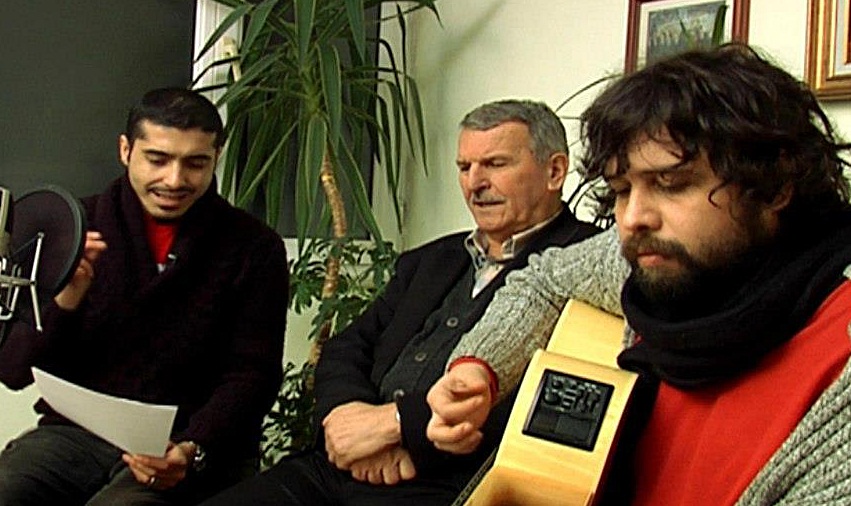
Ferman asks about the instruments. The most important instruments are accordion and doli, a type of drum. They added guitar afterwards to modernize the music.
Şeyma Koç and Samet Sevim

It's time to record some Georgian songs now. Şeyma Koç and Samet Sevim perform two songs from the Caucasus Region.

###
Ferman and Badem

Back in İstanbul. This episode's guest star is rock band, BADEM (Almond). In the briefing with Badem, Ferman states that with every episode, he realized that most of the folk songs started to be sung after a migration. There is generally a sadness on the background of almost every folk song. Whenever they go in Anatolia, there is always a story about migrations with pain and elegies. He asks them what they think about this and how much of that they witnessed in Anatolia. 

The lead singer, Mustafa answers that: They have a deep background with folk music. When they started university, they encountered a book about Karacaoğlan (a 17th century Ottoman folk poet and minstrel). This was also the beginning of the band. They were inspired by that book greatly when they challenged to compose their first songs. They learned the folk music rhythm first and played saz (bağlama) in their debut song. They feel very familiar and close to folk songs. They played even in the ethnic music bars. Before moving on to the rock music, they played folk music for 3 years.

They liked this episode's folk song "Gelino" (The Bride) very much, including the lyrics. Badem will perform the song in Turkish but this song has never been sung in Turkish before. This will be a first for this song. They have also a song called "Gelin" (The Bride) with the lyrics of Karacaoğlan in their third album. They and Ferman are very curious about the final form of the folk song.
Badem's Mert

Mert initially thought that mandolin would be good on this song and makes it sound more innocent. He played a small part with mandolin as a trial on the phone with Ferman. He fell in love with this song as soon as he listened to it and wanted to try something on the mandolin right away. He hasn't brought his mandolin today. 

Ferman thinks that the melody is interesting so much that sometimes it has a Far Eastern vibe about it. Mert says that because it belongs to a region further to the east than Anatolia. Sometimes it sounds like Yugoslavian, sometimes Anatolian. It reflects the effects of the neigboring countries and this is very impressive. He thinks the folk songs carry so many life experiences. 
Ferman and Barış

Bariş adds that Turkish clans migrated all the way from Central Asia to Anatolia leaving most of what they had behind. Many civilizations flourished in Anatolia and maybe these songs have been sung for thousands of years on this soil. This song is about a pain. That's why this is a folk song. They touch somewhere inside and spread from ear to ear just like a newspaper. That emotion spreads and is shared by the people.

Ferman agrees that you can immediately realize that folk songs contain lots of life experiences when you read the lyrics.

When Ferman told Şeyma, the performer of the song that Badem will duet on the song with her, her eyes widened! Ferman hopes Şeyma will love this new form of the song. 

And then they start to work on the rearrangement all together. After they perfected the rearrangement with the Turkish lyrics, it is time to record the song.
Badem's Mustafa records the song

GELINO (The Bride) / Şeyma Koç - Badem

This week's song is a touching Georgian song about a bride who was called by his future husband. And Mustafa's emotional performance was really perfect, reflecting their usual fragile style.

With this episode, Kulaktan Kulaga's first season was concluded. Somehow I feel a big void inside now. I hope there will be a second season in the near future. We visited different regions of Turkey, sometimes close to big cities, sometimes far away, but always full of warm hospitality and great music of various cultures in Anatolia.
I liked seeing musicians work on a song's arrangement and admired all of them very much. I realized that I want to spend some time among them in one way or another if possible. Music is the spice of life, so I'll do my best to encourage my niece and nephew to be great music lovers in the coming years of their lives.

I'd like to express my thanks to Ferman again for being a means for us to realize once again how great Anatolia is and the cultural mosaic is our real treasure. I hope we don't lose that no matter what.

Looking forward to a second season hopefully.


The photos on this blogpost belong to MaNga Greece Facebook Fan Page. Thank you so much, girls! You make my work faster and easier.

You can watch the full video of the episode 13 on the You Tube link below:


FOR FULL KULAKTAN KULAGA EPISODES, PLEASE VISIT TRT MUZIK'S KK VIDEO PAGE:


January 20, 2013

USTAJ FATO USTAJ ZLATO / KULAKTAN KULAGA EPISODE 12

EPISODE 12 / Adapazari Sakarya / 19 Jan 2013

This week Ferman surprises us in his first presentation: He says he is in Norway! The town behind him is Znactanc (?). It means in Norwegian "a haunt of a few people" and the hill are called "the hills of Znactanc". :) He says laughing "I don't know how much of this you believed, but we are in Sakarya Adapazari this week!". He feels himself in far away places, because the snowy landscape of the surroundings of the Lake Sapanca makes him feel in far-off countries. (İNCİ: He is a little playful today. Maybe it's because of the snow. :) Snow makes everybody a little childish! )

The Lake Sapanca in snow

He will be in Adapazari where is very close to İstanbul and as cosmopolitan as İstanbul. He'll listen to many stories and many songs. He'll find out so many things about music due to this cosmopolitan structure of the society. Maybe he'll hear some stories about the earthquake in 1999.

On the way to Adapazari, there is snow everywhere and snow will accompany them everywhere in this episode. He would like to have a beautiful breakfast in a warm place when they get their destination.

A beautiful Bosnian breakfast

Ms.Hadiye Uslu welcomes Ferman and the KK crew in Adapazari. They get a warm welcoming hospitality here. He was daydreaming about a beautiful breakfast on the way and he gets what he wants: an incredibly rich breakfast table! There is Bosnian pastry called zeljanica which is very famous and it's very delicious. And another delicious treat is a kind of Bosnian pickles with yogurt and cream called Soka. In some episodes of Kulaktan Kulaga, Ferman was impressed by the delicious dishes so much that he wanted to make a cooking program.

Ferman at Sakarya University campus

Ferman first visits the Sakarya University campus area which is very important in maNga's musical career. Before maNga's first album, Sakarya University became the place for one of maNga's first concerts. Somehow the university people heard the reputation about the "underground" rock band maNga of Ankara and invited them for a concert. There was a crowd of around 1,500 people. They couldn't believe their eyes! This was an unforgettable concert for maNga, because they played here one night before Limon Bar closed down. And they dedicated one song that night to their friend who died in Ankara.

Ferman takes a stroll on the streets of Adapazari. This is one of the most cosmopolitan cities in Turkey. It's very near to Istanbul and it has major industries located here. However, it's still an Anatolian town. You can come across the people of various ethnic background, such as Laz people, Georgians, Bosnians, Albanians, etc...All of them have been living in Adapazari in peace for ages.

Ferman drops by a game center and returns to his childhood for a while.

Ferman at the Justinianus Bridge

Let's talk about some history now. They are on the Justinianus Bridge ( local people call it "5 Bridges"). One of the most important remains of historical significance is the Justinianus Bridge in Adapazari. Ferman had no idea about the existence of this bridge before Kulaktan Kulaga. It was built around 560 AD. Ferman thought that it was smaller than this, but it has a length of 430 m and seven arches. This bridge was one of the crazy projects of Emperor Justinianus to construct a navigable canal that would bypass the Bosphorus Strait and connect The Gulf of İzmit and the Black Sea. Even though the river beds changed and in spite of the big earthquake in 1999, it's still standing.


Ferman sees that two lovers wrote their names on the virgin snow on the dried river bed. He wants to immortalize it taking the video of it. He says "carved their names" mistakenly and then corrects it as "wrote their names". :)

Ferman is now on the banks of the Lake Sapanca, that's one of the things associated with Adapazari. The region around Lake Sapanca has become very important for day trips and weekend excursions with its charming natural beauty. This lake is one of the forgotten beauties near İstanbul. If we can escape from İstanbul to this lake once in a while, each one of us might benefit from this change of air immensely.
Ferman at the lakeside

Ferman stops over at a lakeside restaurant. The lake has a length of 16 km east-west and 5 km north-south. When maNga is on tour on the way to Anatolia, they often take time to eat fish around this lake. There is an unwritten rule in the lakeside restaurants and it's that you are to eat the fish of the day that is recommended by the restaurant. Trout, roach and barracuda is quite famous as the fish of the lake.
Ferman and Yasar Bey

Ferman introduces us to the owner of the restaurant, Yasar Bey from Artvin. He treats them to tea! He settled in here in 1983. He likes the nature around the lake. He runs this little restaurant with his wife and his children. Ferman asks him "Do you like music?". Yasar Bey likes folk and classical music. Ferman, "There must be lots of things from the Black Sea Region that you miss so much, right?". The nature of the surroundings of the lake is very much alike the Black Sea Region with all the greenery. Also there are so many people from the Black Sea Region living around here. So he doesn't feel himself as a stranger here. As it comes to the music of the Black Sea, they watch satellite broadcasts of the local TV channels of the Black Sea Region.

Ferman asks "Is there a song of Kazim Koyuncu (a folk-rock singer from Artvin who died of lung cancer at 33 in 2005) that you remember? For example, 'Gelevera Deresi' (The Creek of Gelevera) ?". Yasar Bey knows the song but he is a little shy and says that he can't sing it. Ferman tries to persuade him to sing it praising his deep voice and even singing the song a little himself, but to no avail. Yasar Bey just says that he is a good listener. :) Ferman says, "I hope we can meet again in Artvin this time. We plan to visit the Black Sea Region, if we have a second season on this program". Yasar Bey hopes the same thing, too.

The snow landscape impresses the KK crew very much. Ferman takes pictures. It's cold, it's tough, but at the same time it's pleasant.

They started the day with a rich Bosnian breakfast. Now they will listen to Bosnian music at the Adapazari Bosnian Association for Cultural Assistance. The Bosnian immigrants have 14 associations in different Turkish cities and even a federation of these associations. The Chairwoman is Behiye Çark. Ferman will have a short interview with her.

Ferman first thanks her for having them. Ferman's first question is why they are in Adapazari. He didn't know that there was a Bosnian immigrant community here who try to keep the Bosnian folk culture alive.

Ferman and Behiye Hanım

Behiye Hanim speaks as if she reads a poem. :) She thinks that Bosnia and Herzegovina is a country of frozen problems. It's a region of three communities: the Muslims, the Orthodox Christians and the Catholics. This ethnic diversity was a beauty for Bosnians but at the same time it was a big inconvenience. The last 1,000 years of Bosnian history is full of massacres and exiles. This is why Bosnia & Herzegovina and the Balkans is very important in the world's history. Islam affected the region very much with the architecture, civilized style of life and the sense of aesthetics. And of course there are world famous traditional genre of 'sevdalinka' folk music. In musical sense, sevdalinka songs are about love, affection and intolerance.
With the expansion of the Ottoman Empire in the 15th century, the Balkans make a great contribution in both Western and Islamic civilizations. Ferman says that they gave a concert in Bosnia and they have been invited in Bosnia & Herzegovina Film Festival and played there. They were impressed by the scars of war, still visible on the buildings, some of them preserved as they were on purpose. Some destroyed part of the hotel in which they stayed was preserved with all the scars and Ferman as an architect admired the restoration technique that was used. They were able to feel the sadness and pain the war has caused in the city, maybe because they are musicians.


He asks that in case of a wedding, if some relatives are still invited from Bosnia and if the old traditions still alive. Behiye Hanim says that they had forgotten the old traditions mostly, but with the foundation of this association, they remembered and studied the traditions and the music again. They have a folk dance group who performs the Bosnian folk dances. She says that the Ottomans invested in the Balkans greatly and emphasized the importance of the region. Ferman says that TRT also cares about the Balkans so much that they held music concerts with the bands like maNga. MaNga also collaborated with TRT in Bosnia.

She says that music is the life itself and a reflection of what is inside of the human beings just like architecture. In the time of war, the people held fashion shows and operas in the basements of the buildings. They never fell victim to the war. Once after a bombardment, the people cleaned up the debris, washed down the whole neigborhood and they had breakfast right in the middle of the street out of spite.
Ferman and Ahmet Sorgun

Now it's turn to listen to the music. Ahmet Sorgun is going to play harmonica and then Cagatay with his guitar and Ferman with his vocals will accompany him.

Ferman first asks for some information about Bosnian music and sevdalinkas. Sevdalinka songs are about love and the beauties of Bosnia. Ferman says that he heard that they are played with saz and vocals. Ahmet Bey answers that traditionally they are played with accordion in Bosnia, but in Turkey saz is added afterwards. Today Ahmet Bey will use harmonica. Ferman asks why he uses harmonica. This is because of some inconvenience. When Ahmet Bey was young, they needed intrumentalists to play with them in the weddings, but when they couldn't find an instrumentalist to play, he had to learn something easier to play, so he decided to learn how to play harmonica by himself. He plays a Bosnian folk song about a sick girl who wants to dance in a wedding.
Cagatay and his laptop computer

In the meantime, Cagatay is unhappy because he has a problem with his laptop. He thinks that the computer burned down and doesn't start. So they can't connect the recording microphone and the metronome. Ferman asks Cagatay if he thinks he can solve this problem. "Can we solve it, or will we just get out of here without any recording?"
Ferman and Cagatay

Cagatay is hopeful anyway. He thinks he's going to connect the microphone to the camera and use the metronome via smart phones to connect the earphones during the recording. So this means that they are not going to hear their own music and voices during the recording. They have to hope it'll go well. Ferman asks us not to tell this to anyone.

And then they practice the song in Bosnian for the recording. Ferman writes the Bosnian lyrics down for the performance. Cagatay tries to find matching chords on his guitar. And then they perform the song without any problem.

Before leaving Adapazari, the people at the Bosnian association and Ferman dance all together to a Bosnian wedding music. This is their goodbye to Adapazari.

###
Ferman and Mabel Matiz at the briefing

Back in İstanbul. This episode's guest star is Mabel Matiz. Ferman is a little nervous-looking in the briefing with Mabel. It seems that they have just met for the first time. Mabel just released his second album. Ferman wishes him good luck on his new album and says that he can understand how excited he must has been, because they are working on their own album right now. He thanks him for coming to the program. Mabel also thanks him for inviting him to the program. This is very formal. (İNCİ: This is their first time together I think).

Ferman gives him a summary of his visit to Adapazari. In this episode they remake a Bosnian folk song. Ferman sent the song to Mabel beforehand, so he asks him what he thought about it when he first listened to it. Mabel is very interested in the Balkan music. There is this Balkan vibe in his compositions, too. So when he first listened to the song, he was very happy. The song has a very naive vocal music. He's going to perform it in Bosnian and this will be a first on KK. Ferman thinks Bosnian lyrics will match Mabel's voice very much. They talk about how the song should be better for a while and start to practice on the song.

At the end, Ferman asks Mabel if he has been to Bosnia before. No, he hasn't, but he'd love to. Ferman talks about what he saw in Bosnia, the remnants of the war, how the people love movies and the music, how they love to invite Turkish artists, etc...He says, "You should see Bosnia!"
And the next thing to do is to record the song.

USTAY FATO USTAY ZATO (Get Up Fatma, Get Up) / 
Ahmet Sorgun - Mabel Matiz

This week's song is a Bosnian folk song. Mabel performed it in original Bosnian lyrics very softly with a nice-sounding guitar at the background. His soft voice was matching the melody very much.

Next week's episode will be the last of the first season. We don't know if this is the one and only season of Kulaktan Kulaga. We're bombarding TRT's social network addresses with messages and keeping our fingers crossed for a second season! We know that Ferman is in negotiation with TRT for a second season. But nothing is certain yet. We wish you good luck, Ferman!


The photos on this blogpost belong to MaNga Greece Facebook Fan Page. Thank you so much, girls! You make my work easier and faster!


You can watch the full video of the episode 12 on the You Tube link below:


FOR FULL KULAKTAN KULAGA VIDEOS, PLEASE VISIT TRT MUZIK'S KK VIDEO PAGE:

http://trtmuzik.net.tr/Gallery/Video/47/kulaktan-kulaga

January 19, 2013

THE GIVEAWAY CONTEST WINNER!


Many thanks to everyone who took part in my giveaway contest for a chance to win a pretty kai no kuchi fabric jewelry box. The competition has ended last night and I have drawn a lot last night and the winner is....LAURA IKONOMOU from Greece. Congratulations, Laura! I am going to get in touch with you on Facebook today.

As for your precious comments about maNga and Kulaktan Kulaga, I'll do my best to give them to maNga boys on Feb.7 concert as a printed WORD document! This was my goal in the first place anyway. I wish I could get more comments, but these comments are like a summary of how you feel about them anyway, so don't worry! They will know about you, the foreign fans now!

But from now on, please don't hesitate to leave comments about them on my maNga blogposts. Eventually, I'll convey them to maNga.

January 13, 2013

MÜKELLEF / KULAKTAN KULAGA EPISODE 11

EPISODE 11 / Kütahya - Tavşanlı / 12 Jan 2013

In today's episode, Ferman will visit Kütahya Tavşanlı. Early in the morning, on the way to Tavşanlı, Ferman takes video of a sleepy himself. There is fog outside, the road is slippery. Everybody is sleeping. He has just woken up. It's 7:30 am. It will be a long day for them. 
Sleepy Ferman on the way to Tavşanlı

Wherever Ferman visits, he always asks about the weddings. Because weddings are an indicator as to what is listened in that region, if there are less known folk songs around. But in this episode, we'll talk about trousseau, maybe the biggest, the weirdest trousseau in the world: Tavşanlı itself!

The Anatolian Turkish beylik (small principality, governed by a Bey) Germiyan Dynasty with its capital in Kütahya was one of the leading frontier principalities after the disintegration of Seljuks. For a brief period in the second half of the 14th century, Germiyan Dynasty was second only to Karamanoglu Dynasty in its rising power. But they were later taken over by the neigboring Osmanoglu Dynasty, who were to found the Ottoman Empire later.

Germiyan Dynasty was eventually surrounded by newer states established by their own former commanders leaving the Germiyan no outlet to the coastline or to the Byzantine territory. Their powerful Karamanoglu neigbors exerting constant pressure from the east, Germiyan gradually fell under the rising influence of the Ottomans. Germiyan Bey Suleyman Shah sought alliance by giving away his daughter Devlet Hatun in marriage to Ottoman Sultan Murat I's son Yildirim Bayezid. And he transferred Kütahya, Tavşanlı and surroundings to the Ottomans as his daughter's trousseau. Tavşanlı was occupied by the Greeks briefly after the WWI.

Tavşanlı was to be told after a hunting party held by Ottoman prince Yildirim Bayezid I, in which he said to have hunted 7 rabbits. Thus the name Tavşanlı meaning "the place with rabbits" was given to the area.

Ferman goes to The Painter Suna Gürsoy Konuşlu Mansion. They will record some songs in here. This is a 120 year old building. An Armenian builder built it and a man purchased it as a gift to his daughter. Generations after generations, people lived in this mansion happily and Suna Hanim's father has purchased this mansion for her as a present. It must be this mansion's destiny to be purchased for the daughters by the fathers. Suna Hanim is a painter. She paintes her paintings here, exhibits her work here, gives painting lessons here, lives here. The life here is very lively just as once it was. 

Ferman with Aysel Samur

Now we're together with Aysel Samur. She's wearing the authentic costume of Tavşanlı. It's called "bindalli" (meaning "a thousand branches" because of the flower and branch motifs) . It's a traditional kind of wedding dress which is made with generally velvet. It resembles caftans of the Ottoman sultans. The embroidery on it are crafted by people, using real golden thread. This means a real bindalli costs a lot of money!

She sings 2 folk songs and they record it.

Zafer Aydın

Zafer Aydin sings a song for Tavşanli. He is actually from Erzurum. He made this song for 2008 Roasted Chick Peas Festival. 
Ferman in the leblebi shop
 
Ferman wanders around the streets of Tavşanlı. The town is famous for popular snack called "leblebi" (roasted chick peas) . Another city, Çorum is more famous for leblebi in Turkey but in fact leblebi is being sent to Çorum from Tavşanlı. Ferman gets in a leblebi shop in the market place. He wants to taste Tavşanlı's famous leblebi. He asks the shop owner why Çorum is more famous than Tavşanlı. The shop owner answers that leblebi is native to Tavşanlı but Çorum's location is more convenient than Tavşanlı. He sells 43 different types of leblebi in his shop. Ferman asks about a particular peppery leblebi and yes, there is that, too. When he was a kid, he attended swimming classes and on his way home he ate peppery leblebi as a treat for himself.
Ferman at Public Education Center

After that, Ferman arrives at Tavşanlı Public Education Center. Tavşanlı is not the first name that comes to mind. When we say leblebi, Çorum is the first thing that comes to mind and when we say coal mine, Zonguldak is the first thing that comes to mind. But Tavşanlı's Tunçbilek Coal Co. is very important for Turkey. Similarly, when we say zeybek, the first thing that comes to mind is Aegean Coast, but Tavşanlı has zeybek, too. Tavşanli's zeybek is a bit different. Ferman will get information about the zeybek at Public Education Center. 

Ferman getting information about Tavşanlı zeybek

He is with Mehmet Özer and Firdevs Keskin. Ferman says that even though İzmir and Aydın's zeybek are first to come to mind, Tavşanli has zeybek, too. He asks what the differences are. Mehmet Bey says that İzmir and Aydın have slow zeybek, but Kütahya has fast zeybek with spoons. The costumes are a little different as well. The embroidery on them are more detailed and colorful. The emboridery motifs tell a lot of things: wealth, poverty, etc... 

And Kütahya zeybek is danced solo, too. And they watch a cool zeybek dance. 


There is an project where the people at Public Education Center compile the old folk songs and dances that are about to be forgotten and they are now archiving them. They want the folk dance groups and students to use these compiled dances in the competitions. And they are aware that this is a big task for the future.

Tavşanlı is a pretty town just as all the other Aegean towns, but at the same time it is kinda gloomy. Situated between Aegean and Central Anatolian Regions, you can feel the gloominess of Central Anatolia in Tavşanlı. This is the effect of the big coal mines nearby. There are prominent coal deposits here in Tavşanlı. 

A street in Tavşanlı

They record a folk song at Public Education Center. Halil İbrahim Kesen sang his own song. And this is a song called "Mükellef" that reveals this gloomy feeling. In the 1940's, a law was enacted to find workers to work in the coal mines of Tavşanlı. It was called "Mükellef (liable) Law" and according to this law, volunteer convicts, young men at the age of military service, villagers without land or proper connections were made liable to comply with the law and forced to work in the coal mines. Because it was very hard to find people to work in the mines. This is a sad story of Turkey.

The next stop is the coffee house now. Tavşanlı and mining is inseparable. This connection was a movie's theme years ago. MADEN (Coal Mine), story and directed by Yavuz Özkan, was filmed in Tavşanlı in 1978. Ferman works with him on his latest movie project, so he calls Yavuz Özkan and informs him that he is now in Tavşanlı. He says him that he wanted to go to the hamam in which the movie's last scene was taken, but couldn't get in, because it was the women's day in the hamam. :) Ferman is cheerful like a child when he speaks with him. He says that he is going to watch the movie once more to make a comparison when he gets back. 

Ferman on the phone with movie director Yavuz Özkan

After he hangs up the phone, he says that Yavuz Özkan is a very important movie director and MADEN is also important for Turkey's movie history. Tavşanli has produced many artists. One of them is maNga's own Özgür! He is also from Tavşanlı!

Ferman and his birthday cake

It gets dark and the Mayor of Tavşanlı, Mustafa Güler welcomes him and KK crew at the dinner. Ferman and his crew have to experience everything on the move, because they are mostly on the road for KK. Today is Ferman's birthday and KK crew don't forget that! And at the dinner, they celebrate his birthday! He welcomes his 33rd birthday in Tavşanlı, a little tired, a little cold, but really happy!

Now it's time to go back to İstanbul. Özgür suggested Tavşanlı to Ferman. He takes good memories full of music back home from Tavşanlı. He could manage to talk about music with almost everyone here. Above all, he celebrated his birthday here in a circle of friendship and music.

###

Ferman and Erdem Yener
 
Back in İstanbul. This episode's guest star is rocker and comedy actor Erdem Yener. Ferman gives him the directions to the maNga's studio on the phone, but to no avail and he has to meet him at the entrance of the main building. This is a first on Kulaktan Kulaga. :) Ferman says him that this is a real welcome for the first time on KK! :)

Ferman and Erdem have been friends since "Sing Your Song" music competition 11 years ago and this is something that many people don't know. Erdem and his band +4 were eliminated in the early rounds, but maNga managed to finish the competition runner-up. +4 was also from Ankara and the 2 bands were buddies during the competition. +4 also recorded their demo tapes in the same studio in Ankara with maNga, Volkan Abi's studio (Please see KK episode 9/Ankara). This was the first step to their friendship.

Erdem recorded a single called "Belki (Maybe)" after the competition. It became a popular song radio stations play the most. But one day he fell off from the staircase at home and broke his heel. This was a pause in his music career and he withdrew into himself badly. He rented a house on the Mediterranean Coast and isolated himself. On the fourth day in that house, he got a commercial offer for a GSM operator (AVEA). It was 2010. This was not the first time he thought about acting. He had a little experience from years ago. In fact, he didn't stop his music career; he continued to give concerts; he was on tour in Anatolia in March 2012. He's going to release another single very soon. He missed working at the studio and wants to make an album this year.

Ferman asks him if he had been to Kütahya before. Erdem had been in downtown Kütahya for a +4 concert. They played in a big party as the main attraction. A small band played before them and then +4 started playing their first rock song with their electric guitars and everybody ran away! A small group of people kindly stayed to listen to their interesting music. Erdem remembers that there was only a monitor on the stage, but it was facing the audience and that night they somehow managed to play music without hearing one another. This is his only memory with Kütahya.

Ferman's next question is if he ever has sung a folk song before or not. Erdem didn't recorded any folk song but his family like folk songs. Erdem doesn't listen to folk songs, but he likes to listen to folk singers who make a difference with their music. There is someone he likes and it's late minstrel Neşet Ertaş. 

Ferman and Erdem practicing on the song's rearrangement

Ferman gives some info about this week's folk song to Erdem. Tavşanlı's folk songs are interesting; cheerful, as well as gloomy; the lyrics are heavier due to being a mining town. Gloominess comes from Central Anatolian part of Tavşanlı. The music is a mixture of Aegean and Central Anatolia. And then they listen to the song. After that they start to speak about the rearrangement in a language that sounds like French to me and only the proffesional musicians can speak and understand. It was fun to listen but I didn't understand much. :) dim dim dim tis tis...gum gum gum tak...

They had great fun practicing on the song with Erdem in the recording room. At one time, Ferman asks him jokingly if he could do drums with his mouth as well. :) 


At the end, Erdem performed it very seriously after a chain of jokes in the recording room. There is a Barış Manço vibe about the rearrangement which has quite a contribution from Erdem, too. 


Mükellef (Liable) / Halil İbrahim Kesen - Erdem Yener 

This episode's song is a sad requiem for the coal miners who killed in various accidents underground. There is even a dedication note during the end credits and this episode was dedicated to the 8 coal miners who killed last week in a mine explosion due to a gas leak in Zonguldak.

Next week, where will he be and with whom? This is still a mystery...:)


T
he photos on this blogpost belong to MaNga Greece Facebook Fan Page. Thank you so much, girls! You make my work easier and faster!


You can watch the full episode 11 on the You Tube link below:


FOR FULL VIDEOS OF KULAKTAN KULAGA, PLEASE VISIT TRT MUZİK'S KK VIDEO PAGE:

http://trtmuzik.net.tr/Gallery/Video/47/kulaktan-kulaga